Wednesday, June 24, 2009

Interlaken to Lucerne via Golden Pass Scenic Route


We had our lunch at Migros in Interlaken and then set off for Lucerne. We had reserved seats on board the Golden Pass Panoramic train from Interlaken to Lucerne. The view was impressively fantastic and different from the views of the previous train trips as this stretch gave us the view of the magnificent landscape of the Lake Region.


We reached Lucerne, which called out for attention the moment we rolled into the station in the middle of town. From the train station, a short walk took us to the pier. From there, the leisurely refreshing Lake Lucerne Steamer (SGV) brought us to Hertenstein. It was a lovely 25 min cruise from Lucerne to Hertenstein Lake Lucerne is beautiful!


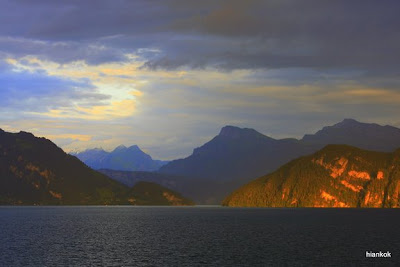
Our hotel, Wellness Hotel Graziella, was a short but uphill walk from the Hertenstein ferry station. We were very happy with our stay at Hotel Graziella. The hotel is situated just a stone's throw away from Lake Lucerne and our room’s picture-window-and-door gave us a clear, uninterrupted view of the lovely lake. For two nights, we watched the sunset right from our bed as sunset came late, as late as 9pm. It was truly spectacular as we woke up and went to bed with the fantastic view of the mist-shrouded lake and the mountains at the horizon. Sunsets were very dramatic and intense, right out of the novels of Jane Austen


I think the we got a good deal for the hotel was reasonably priced at 180 fr per night (200fr on Saturday night) and it came with a good breakfast spread, bathrobes and bottled sparkling and still mineral waters in our room, a variety of teas and fruit in the lobby, free internet access throughout the hotel. We could also have free access to the sauna, whirlpool and a number of other stuff which we didn’t use as we were more interested in what was outside the hotel. The hotel clients were mainly German speaking but they were friendly and we had our international language of SMILES and everyone understood what ‘Good Morning’ and ‘Hello’ meant. We learnt "morgan" and "merci" meant "morning" and "thank you".


The hotel staff spoke good English though and they were friendly and helpful. Of course, we had a really great stay there - a place to look forward too after a hard day out in the town or eating up the trails. It seemed all our stay had been great but what can I say – it had been great, great, great so far. But I wish everything wasn’t so expensive! Nevertheless, if you have to choose a country to visit, choose Switzerland! You wouldn’t be disappointed!

Interlaken

We woke up early, all ready to continue our mountain hike from Murren to Gimmelwald, a mountain village made famous by Rick’s travel guide. Alas, we were disappointed as the rain was heavy and the mountains were almost completely shrouded with thick cloud. This translates to bad news - visibility would be poor. Not prepared to gamble on our limited time, we gave it a miss.


We visited Interlaken instead. We deposited our luggage at the coin-operated locker at Interlaken East train station to be picked up on our next leg from Interlaken East to Lucerne. The choice we made was to make our way from Interlaken Ost (East) to Interlaken West on foot. Along the way took in the town. We window-shopped as we strolled down Interlaken’s main street. We took a sneak peek at the Japanese Garden, which is Switzerland’s first Japanese garden. As we have seen the beautiful gardens in Japan, the Japanese Garden in Interlaken is, well, to put in nicely - unremarkable.


We headed to Unterseen, which is Interlaken's oldest segment of the city. This picturesque village is well worth a visit.


We spent the rest of our morning just relaxing and enjoying the lovely cool weather and the view of the distant Jangfrau Mountains as we sat at a spacious park, Hohematte, drinking our beer and watching the Para gliders streaming down from the highlands behind the town to land in the middle of the town-park in front of us.

We loved the sights and sounds of this pretty, quiet and relaxing town like this view of the dog walking the horse


and we even watched a civil defence drill of how to save someone trapped in a car that has been crushed and the door cannot be opened.


Interlaken is a indeed a pretty town. Nevertheless, we were glad we made the choice to stay at Lauterbrunnen rather that Interlaken. Lauterbrunnen is situated in one of the most impressive trough valleys in the Alps, between gigantic rock faces and mountain peaks. With its 72 thundering waterfalls, secluded valleys, colourful alpine meadows and lonely mountain inns, the Lauterbrunnen Valley is one of the biggest nature conservation areas in Switzerland. And our Staubbach hotel has the view of the mighty Staubbach falls. I wouldn’t have minded staying at Murren too – perhaps the next trip?

Sunday, June 21, 2009

2nd Day at Lauterbrunnen

Breakfast view from hotel Staubbach

After a good breakfast, we headed out immediately to our planned hike. The wet weather and disheartening weather reports required us to start our day early. We took the train to Wengen which was another scenic ride with views of mountains, cliffs and waterfalls.

We then took a gondola ride up to Mannlichen and the view of the town of Wengen was lovely. The ride up to the cliff-face offered a very pretty sight markedly improved by the dampness of the morning and the showers the night before. The air was crisp and the morning freshness truly perked up the spirit. The ride up the gondola took us through the low hanging clouds that peppered the landscape. Visibility was crystal clear except when the clouds got blown our way.


Upon reaching the top at Mannlichen, we had a glimpse of the beautiful Bernese Alps.


However, within minutes, the clouds moved in and the window of opportunity for great shots of the valleys below and the peaks above became very limited. Within minutes, the clouds moved in and we were shrouded in thick fog. Visibility was reduced to about 10m. The very light rain made our fleece and the windbreaker insufficient. Out came the ponchos, which came in very handy indeed for this and subsequent hikes.


The trail we took was the Mannlichen - Kleine Scheidegg trail which is an easy 80min trail stretching over 5km with a difference in altitude of 126m ascent and 284m descent. Such published information made trail-selection much easier as we could decide on the trials appropriately matched to ability and endurance level. The panoramic view of the beautiful Eiger, Monch and Jungfrau, as well as Grinderwald, Grosse Scheidegg and the Wetterhorn was the reward for the energy put into the walk. The possibility of seeing animals along the way would be a real treat - marmots and chamois. The trails took us through ice-fields, much floral varieties and, where the clouds were kind enough we could see the world around us. The shroud of clouds only offered pockets of teasers of what a clear day would bring - truly awe-inspiring. Towards the end of the trail as we approached the view-station of the Eiger, the skies cleared and the hidden beauties of the glaciers and the snow-capped peaks were revealed. The hunger for the beauty of the hike was only partially satisfied. The cloudiness and the dense fog along the trail only offered us little bites of the real beauty and left a much to the imagination.


By the time we headed back to Lauterbrunnen on the slow scenic ride on the train, we were hungry for lunch. We headed to the restaurant at Hotel Oberland. Known for their friendly service and good food, we were not disappointed. The chirpy Polish-Spanish waitress was extremely friendly and welcoming. We had a small meal of a pizza and delicious vegetable soup with some bread, dipped into an interesting spicy sunflower oil, spiced up with a range of herbs soaked in the bottle. Wonderful meal, topped up with a half-pint of the local draft.

After lunch and due to the heavy rain, nothing else could be done except to blog and publish the pictures on the web-albums.

When the skies cleared in the later part of the evening, we headed for the Staubbach falls. The magnificence of the majestic high free-falling waters beckoned every moment we laid eyes on it. It took us only a couple of minutes from the hotel to the foot of the falls. We were enticed to follow the trail to the foot of the falls. The sight of people going up there with their brollies alerted us to being prepared. Stowing away our camera into the weather-proof bag, we donned our ponchos and headed up the steep climb along the path. As we approached the base of the fall, the feeling was like we were in a very misty spray of light rain coming in all directions. As we walked through the tunnel under the waterfall, we could hear the roar of the falling waters and the 'light rain' became heavier as thirty tons of water fall every minute over a height of 400m splashing onto the bare rocks below. We went into the walkway behind the wall of falling water. Our ponchos were ineffective against the energy of the splashing waters. Water came from everywhere, as if we were in a hurricane, pounding loudly and blasting our bodies with jet-sprays of water.

Being unprepared, we dared not venture further. We surrendered and turned back to the safety of our hotel room nearby.

Friday, June 19, 2009

Glacier Express from Zermatt to Disentis

Took a ride on the world's slowest express train from Zematt to Dementis. The one of a kind Glacier Express - acclaimed indisputably as one of the most beautiful stretches of railway in the world. The train itself is a showpiece- air-conditioned panorama coaches gliding gently through the sharply-aromatic mountain forests and still mountain pastures.

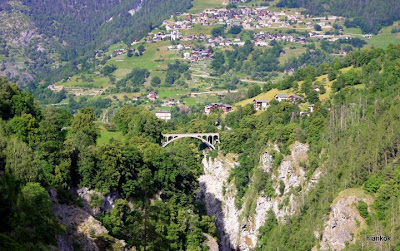
The different sounds that emanate from the train is caused by the train passing over one of the 291 bridges. In the course of the journey, we went into the Alps through a tunnel in the mountains, a journey of 15 minutes over 15.4 km of a U-shaped tunnel linking us from Oberwald to Andermatt, over an altitude change of about 1000m. This is the longest tunnel in the Swiss Rail Network.

The panaramic design of the cabins were available for the first time this summer of 2009. Through the panoramic windows, there was always the beauty of nature cradling you, all over, 360 degeess all round. We were in the first class wagon.

There were waterfalls, raging rivers under bridges, rolling plains with sheep, farmsteads on farmlands on slopes peppered with cluster of trees. Mountain-landscapes were "one of a kind". The route involved passing through the Rhone Valley, the Groms and into the Furka basis tunnel before reaching Andermatt and the renowned Oberalp Pass through glacier landscapes. At the highest part of our journey, we were surrounded with ice fields slowly melting into streams cascading over uneven terrain and these were what made the numerous waterfalls as we reached the valleys.

For the records, there are other facts about the trip. The highest bridge the train rolls over is 45 meters high over the river. There were 33 tunnels. There are sections of the railroad where the gradient does not allow the engine to pull has to be supplemented by cogwheel. These total to 31.9 km of cogwheel section.

We were fortunate to be on this train, as it had been attached with the restaurant car on its final year of her 50 years of service. The car was basically wooden in construction and the fabric of the seats was visibly evident of their 50 years of distinguished service. It is a matronly car warm in feel and exudes an air of respect. A simple lunch in the dining car was a memorable experience. Lunch took the appearance of a romantic dinner each time the train passes through the darkness of a tunnel. The lunch was reasonably priced and cheaper than some of the city cafe we ate in. We had Goulash soup which was really good as it came with generous chunks of meat and vegetables and was quite filling.

Our destination was Desentis, which was what our schedule for trips allowed for. A picturesque little town, Desentis is the largest Romansh-speaking community in Switzerland.

The village is dominated by the monastery and the church with its double spires which date as far back as 1683. The monastery of St. Martin, founded in the 8th century, is one of the oldest Benedictine monasteries in Europe. The Baroque collegiate church, dating from 1712, with its two onion-domed towers and rich stucco work and painted ceilings is one of the most important sacred buildings in Grisons. The church hall was a magnificent sight. Paintings depicting events in the bible were found on the ceiling and walls and these complement the bright golden ornate designs on the columns and the altars.